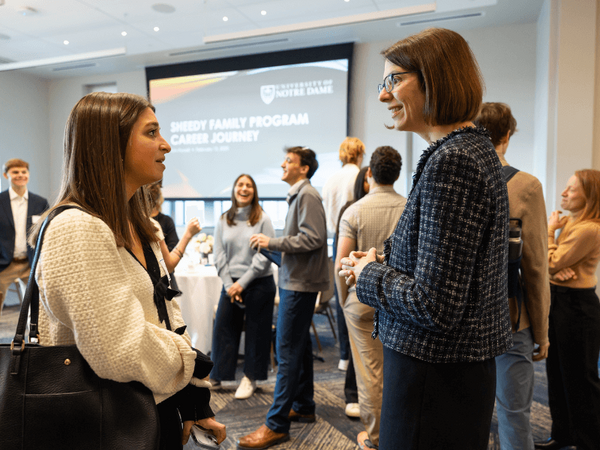
tag:sheedyprogram.nd.edu,2005:/news-and-events/newstag:sheedyprogram.nd.edu,2005:/latestSheedy Family Program in Economy, Enterprise, and Society | News2026-11-14T10:55:00-05:00The Sheedy Family Program is a rigorous intellectual community for Notre Dame students in the College of Arts & Letters with interests in business.tag:sheedyprogram.nd.edu,2005:News/1875362026-11-14T10:55:00-05:002026-11-14T10:56:36-05:00Patrick Vassel ’07 invites Sheedy students to the room where it happens
“How do you know you are in the right room?”
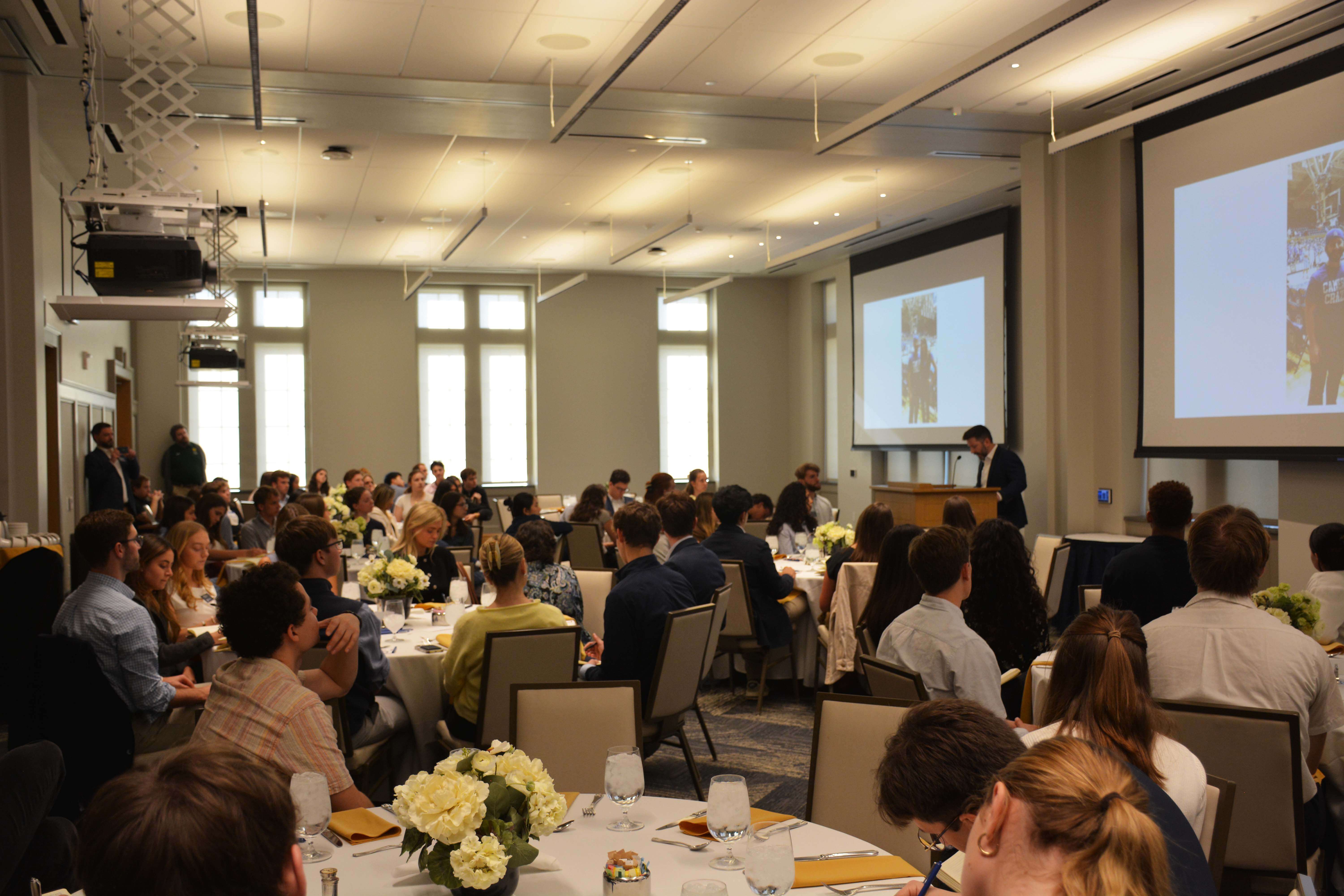
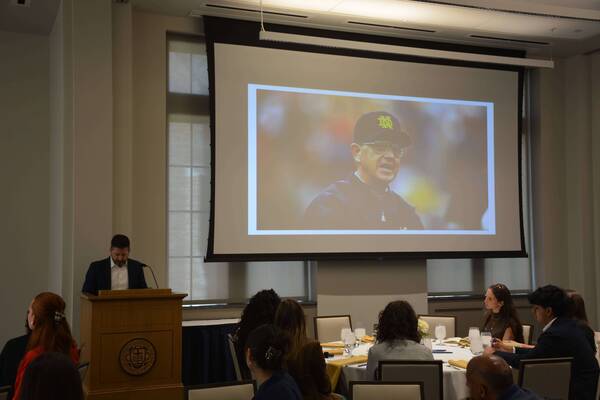
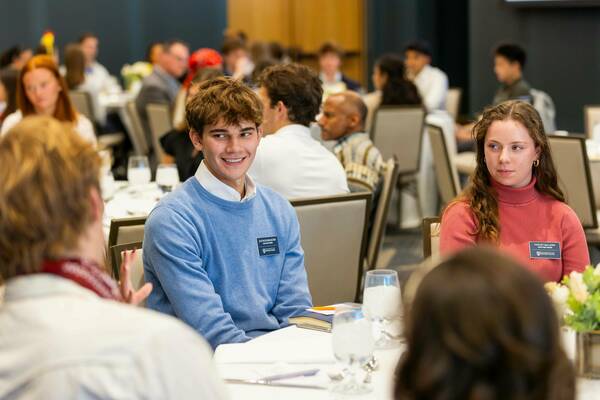
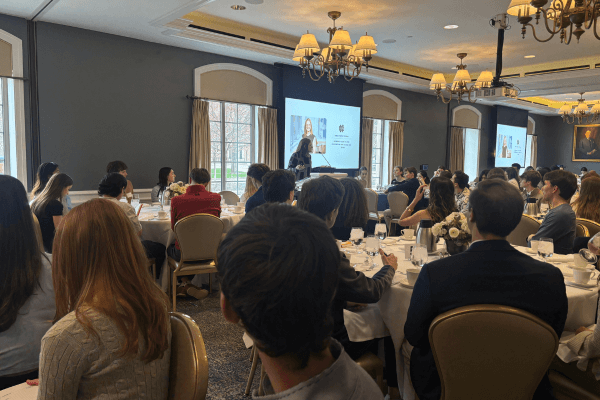
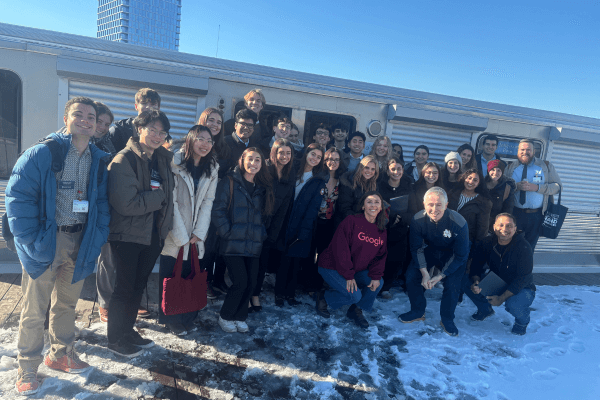
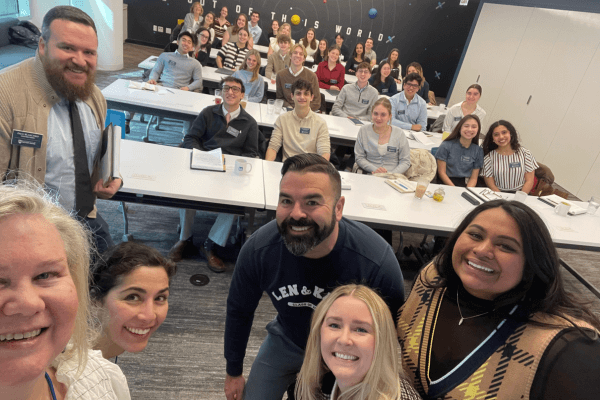
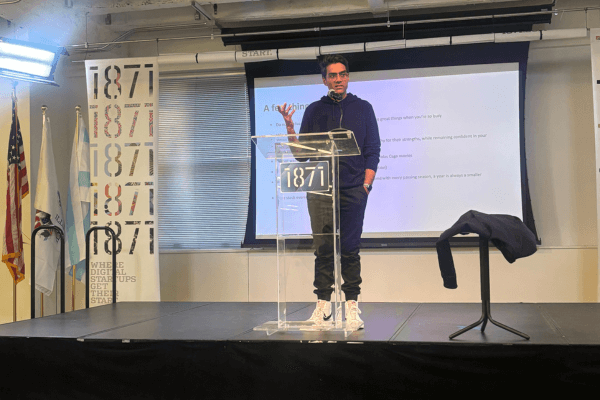
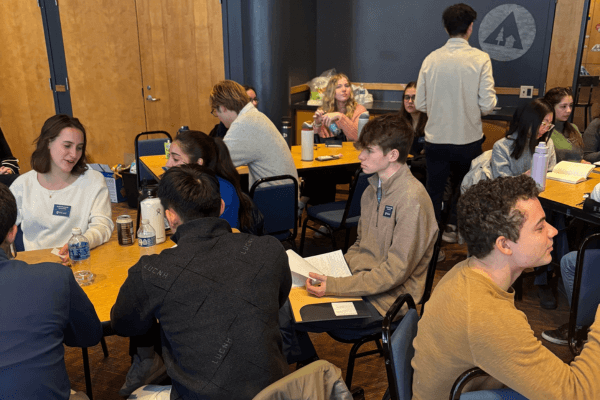
Patrick Vassel (’07) posed this question to Sheedy Family Program students and faculty at the program’s opening Dinner & Dialogue event for the Fall 2026 semester.
Vassel has had a remarkable run as the associate and supervising director of the hit musical Hamilton. But as an undergraduate, he had his sights set on a different field: government. He studied political science, minored in public service, and participated in Notre Dame’s Washington Program. He loved theater—and even directed a student production of A Few Good Men—but he approached it as a hobby, not a career path.
A stint with Teach For America brought Vassel to New York City, where he could immerse himself in the theater industry alongside his work as a teacher. In 2014, he received an extraordinary opportunity: to help produce a new show called Hamilton.
But landing the job did not immediately bring the sense of certainty he might have expected. The show had not yet experienced its meteoric rise to fame as one of the most highly awarded, culturally influential, and fastest-grossing productions in Broadway history. “When I got there, I was not sure I was in the right room,” Vassel said.
Vassel used his story to raise questions about knowing when to leave a room and what holds us back from pursuing our passions. He invited students to reflect on the risks of stepping outside familiar paths, the patience required when opportunities don’t materialize, and how even the wrong rooms can help clarify where we belong.
He also encouraged students to think critically about the rooms they occupy, the ones they hope to enter, and the ones they may need to leave, urging them not to let expectations of what they should be doing prevent them from pursuing what genuinely interests them.
“The world does not need people doing what they think they should be doing but don’t truly have a passion for,” he explained.
For students still discerning their paths and seasoned professionals considering other opportunities, Vassel offered a reminder that finding the right room is not always a matter of knowing exactly where to go. Sometimes, it begins with the willingness to knock on an unfamiliar door.
Luke Donoghue (’27) is pursuing a double major in finance and global affairs with a minor in Chinese. His previous experience includes working in a congressional office and interning with a government consulting practice in Washington, D.C. Following graduation, he will join McKinsey & Company’s Chicago office as a business analyst.
]]>
Luke Donoghuetag:sheedyprogram.nd.edu,2005:News/1813312026-05-01T11:54:00-04:002026-05-01T11:54:49-04:00“What’s important now?”: Paul Jacobs (‘07) shares formula for navigating career and life decisions
In March, Notre Dame alumnus Paul Jacobs (‘07, aerospace engineering) encouraged students to rethink how they approach career planning by starting with a simple question: What’s important now?
Speaking as part of the Sheedy Family Program’s Dinner & Dialogue series, Jacobs shared that the question came from legendary former Notre Dame football coach Lou Holtz. Holtz, who had been honored and laid to rest at Notre Dame earlier the same week, often used the “What’s important now” (or “WIN”) formula as a mental tool to focus attention on the present moment.
Paul Jacobs pays tribute to Lou Holtz during a Dinner & Dialogue event
For Jacobs, the WIN formula has served as a practical framework for navigating his career, from the Air Force to NASA to business school and, finally, to his current role as a Product Manager at Google. Jacobs emphasized that his path was far from linear, with many moments of uncertainty. He told students that while long-term plans can be helpful, they are often less valuable than the ability to identify priorities and act on them in the present.
Jacobs said his WIN mindset began to develop during his time at Notre Dame. After moving frequently during his childhood and young adult years, Jacobs found a strong sense of community and developed a close-knit group of friends after arriving on campus. “Notre Dame was the first place I truly felt at home,” he said. “Being surrounded by the same friends changed my life in so many positive ways, and I never wanted to lose that after graduation.” So the “Man of the Year” was born. He and ten of his closest friends from Dillon Hall select a “Man of the Year” who then becomes responsible for coordinating next year's event. Now, nearly two decades later, the tradition continues—as do the connections he built on campus.
Following graduation, Jacobs was commissioned into the Air Force, where he took on roles that required him to adapt quickly and manage significant responsibility. Answering the question “What’s important now?”, he sought out opportunities to expand his experience, including helping reestablish a collaboration with NASA’s Jet Propulsion Laboratory. At NASA, Jacobs encountered a workplace culture that differed from what he had experienced in the military. He noted that open discussion and questioning were encouraged at all levels, which influenced how he later approached leadership and teamwork.
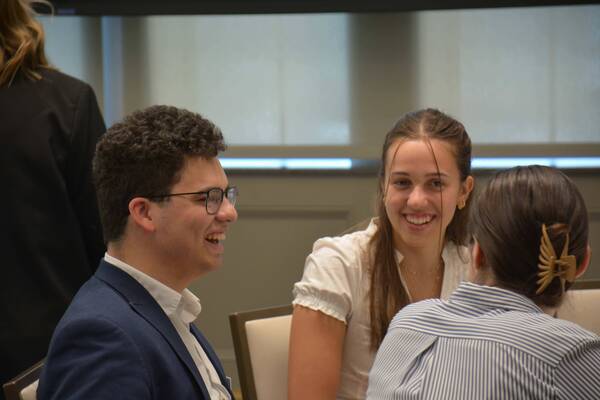
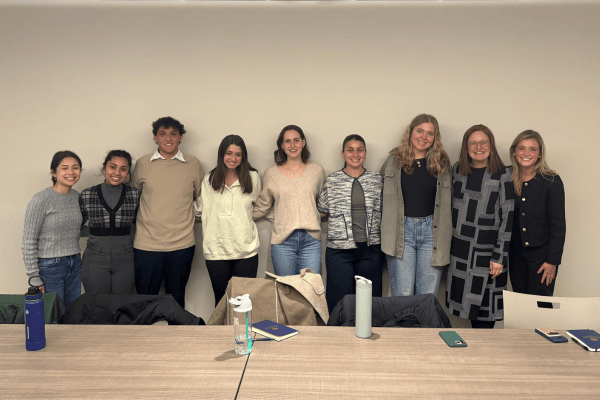
Nathan Ward ('28), Maya Parafiniuk ('28), and Jayne Kelly ('27) at the March 2026 Dinner & Dialogue event
Next, asking “What’s important now,” Jacobs took an opportunity rarely offered to astroengineers: deployment. When he heard of an assignment opening in Kandahar, Afghanistan, he jumped at the opportunity. “I knew I wanted to find a way to serve in a way that would challenge me, and I didn't want to look back at my military career and only see images of me behind a desk.”
In Afghanistan, Jacobs oversaw key infrastructure on a large military base. He said the experience reinforced the importance of relying on others, making decisions under pressure, and staying focused on immediate priorities.
After completing his military service, Jacobs attended business school and transitioned into the technology industry. Despite his professional success, Jacobs said he reassessed his priorities after he and his wife experienced a miscarriage. That experience shifted his focus. “It wasn’t about the next achievement,” Jacobs said, “It was about my family, my faith, and the way I was living my life each day.”
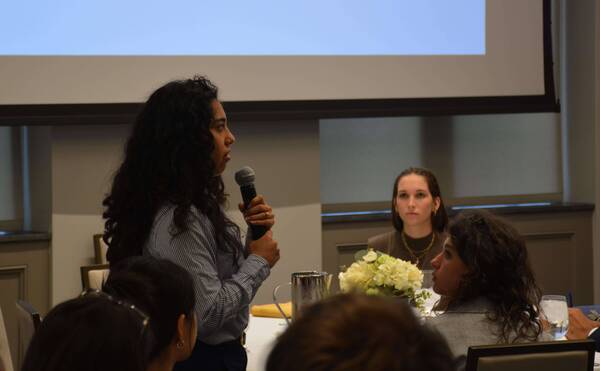
Marcela Rodriguez ('26) fields questions during the March 2026 Dinner & Dialogue event
Today, Jacobs balances his work at Google with a family life that now includes two young children. He said the demands of his career remain high, but his decision-making approach has become even more consistent. He continues to rely on the WIN formula to align his daily choices with his long-term sense of purpose.
For students, many of whom feel pressure to define their future early, Jacobs offered a different perspective. Long-term thinking has value, he said, but it should not come at the expense of living out your values on a day-to-day basis.
Jacobs’ story was a reminder that although career paths are rarely predictable, the ability to reassess priorities and make intentional, values-driven decisions remains within our control.
Caroline Mezzalingua (’28) is a Political Science major from Skaneateles, New York. A member of the Glynn Family Honors Program, she is also pursuing minors in Foundations of Business, Marketing, and French.
Contact
Brett Beasley Sheedy Family Program in Economy, Enterprise, and Society 203B O'Shaughnessy Hall University of Notre Dame Notre Dame, IN 46556
About the Sheedy Family Program
The Sheedy Family Program in Economy, Enterprise, and Society is a robust intellectual community. Students, faculty, and industry leaders explore the intersections of business and the liberal arts through rigorous coursework, collaborative research, meaningful dialogue, and purpose-driven career discernment.
]]>
Caroline Mezzalinguatag:sheedyprogram.nd.edu,2005:News/1791832026-02-13T12:27:00-05:002026-02-13T12:27:36-05:00Sheedy Program Connects Liberal Arts and BusinessIn The Observer, Maria Alice Souza Maia reports on the vision and success of the Sheedy Family Program in Economy, Enterprise, and Society:
The Sheedy Family Program in Economy, Enterprise and Society is composed of a cohort of 25 to 30 students, led by director of the program Paul Blaschko, who are encouraged to foster deep and sustained dialogue through lasting relationships within the community.
“The Sheedy Family Program is a rigorous intellectual community that supports students studying business and liberal arts by encouraging them to connect these interests. The community aspect of this is crucial,” Blaschko wrote. “By studying what they love, and then integrating that into their aspirations for work, we want our students to develop the skills and confidence to find work that’s meaningful and significant.”
Calling members of the program “Sheedy’s,” students in the cohort take classes together while also participating in networking events and off-campus experiences.
“Sheedy’s” take three classes together. Business in Context, taught by Prof. Chris Hedlin, asks them to explore big questions like ‘What makes an economy just?’ and ‘When is business good?’ The second class, the one I teach, is focused on work, meaning and happiness. And the third is taught by two investors-turned-podcasters, Rick Buhrman and Paul Buser, who apply these questions through dialogue and experiential learning, like trips to investing conferences or short immersion experiences like internships,” Blaschko wrote.
]]>
Maria Alice Souza Maiatag:sheedyprogram.nd.edu,2005:News/1789462026-02-03T16:49:00-05:002026-02-20T22:30:56-05:00Notre Dame home to national collaboration to strengthen critical thinking and civil discoursePaul Blaschko leads a class in the First Lecture Series at Welcome Weekend, giving new Notre Dame students their first taste of academic life in the College of Arts & Letters. (Photo by Jon L. Hendricks/University of Notre Dame)
Led by a team of faculty, civic institutes, and nonprofit partners across the U. S., the ICDC project brings together educators across institutions to integrate critical thinking and civil discourse at scale.
The University of Notre Dame has been awarded nearly $4 million in a four-year grant from the U.S. Department of Education (DOE) to fund a new initiative that will incorporate tools and strategies for teaching critical thinking into college classrooms around the country.
Supporting a project called Integrating Civil Discourse into the Curriculum at Public, Private, Community, and Historically Minority-Serving Colleges and Universities (ICDC), the grant comes out of the DOE’s Fund for the Improvement of Postsecondary Education Special Projects Program, which focuses on, among other priorities, protecting and promoting civil discourse in higher education.
In support of that mission, ICDC brings together a team of faculty from universities and colleges around the country with nonprofit leaders to integrate two online technologies that teach critical thinking into undergraduate curricula.
“We’re going to ask this question, ‘Can we expand the reach of effective critical thinking strategies in ways that could impact how we dialogue with each other on a national scale?’” said Paul Blaschko, an assistant teaching professor in the Department of Philosophy and director of the Sheedy Family Program in Economy, Enterprise, and Society. He and North Carolina State University professor Gary Comstock are leading ICDC as co-primary investigators.
Blaschko has been using ThinkArguments, one of ICDC’s two technological tools, for over three years to teach philosophical argumentation in the signature Notre Dame class God and the Good Life. Produced by the nonprofit ThinkerAnalytix, ThinkArguments is an online course with 10 lessons that train students in argument mapping, a method of informal reasoning that visualizes the structure of an argument. The course has thousands of LSAT-inspired practice questions targeting different critical thinking skills.
“Teaching is a core part of Notre Dame’s mission, so to have an institutional stake in education in this country on a broader scale can be one crucial way we live out that mission.”
Blaschko noticed the impact of ThinkArguments in his classes the first time he used it.
“The arguments students were offering — it just seemed like something was clicking that hadn’t been clicking before,” he said.
To quantify that change, Blaschko started measuring students’ critical thinking gains with pre- and post-tests. He recorded an average growth rate of 16% — a significant improvement. It was something he wanted to replicate.
That’s where ICDC comes in. The grant, administered by Notre Dame Research, will fund summer workshops that convene faculty from around the country to train them in the basics of ThinkArguments and how to effectively integrate the technology into their courses. They’ll also use the tool Sway, an AI chat platform that coaches students with differing perspectives through difficult discussions. Disagree Wisely, a Florida nonprofit, leads research on Sway's educational impact and supports its deployment across institutions. The impact of incorporating the two technologies into hundreds of classrooms will be measured in the same way Blaschko did it.
The project has the potential to break new ground in higher education. While critical thinking skills are often touted as a key outcome of a humanities education, Blascko said, actually teaching and assessing critical thinking competence is challenging, especially in larger classes. ICDC’s strategies confront this issue by narrowing in on a concrete set of skills that can be applied in any situation involving a search for truth.
“Students are gaining habits of mind that they can apply in reading comprehension, writing, and verbal argumentation and dialogue, both in the classroom and outside of it,” Blaschko said.
Blaschko and the other members of ICDC’s steering committee estimate the project will reach more than 100,000 students just within the grant’s lifetime, with an even greater impact beyond the next four years as their research advances critical thinking education in the U.S.
“It’s really meaningful to be working with the Department of Education on the front lines of pedagogy, research, and practice,” Blaschko said. “Teaching is a core part of Notre Dame’s mission, so to have an institutional stake in education in this country on a broader scale can be one crucial way we live out that mission.”
Originally published by Adah McMillan at al.nd.edu on February 03, 2026.
]]>
Adah McMillantag:sheedyprogram.nd.edu,2005:News/1786692026-01-23T14:16:00-05:002026-01-23T14:16:19-05:00Sheedy scholar awarded Franco Institute Undergraduate Public Humanities Internship
The Franco Institute kicked off its inaugural semester of the Undergraduate Public Humanities Internship (UPHI) in the spring of 2026.
The internship comes as part of the Franco Institute’s expanded mission to foster the liberal arts’ engagement with the public good. As a disciplinary focus, “public humanities” bridge the gap between scholarly production and public engagement, fostering collaborative efforts to explore the world and our uniquely human place within it. The UPHI offers students the opportunity to use their humanities skills in service to their community while learning how knowledge is produced through the lives, actions, and experiences of community members.
This year's seven student interns from the College of Arts & Letters met together for breakfast and orientation on Friday, January 16, with Franco Institute staff members Lindsay Paturalski, Jake Schepers, and Emmanuel Ojeifo. The students learned about the internship’s expectations and explored best practices and methodologies for public humanities research.
All students receive support from the Institute during the spring 2026 semester as they work with their respective community partners and prepare research related to this year's annual research theme of Attention. In addition, the interns will present their work as part of a poster session at the Institute's Day | Merton Symposium in April. "It's exciting to see this terrific cohort of Arts & Letters students working at the interface of humanities research and the publics to whom it matters. We're looking forward to a great first semester of public humanities work and to celebrating that work at our spring symposium," said Kate Marshall, the Institute's Director.
The Franco Institute is pleased to share its incoming class of the Undergraduate Public Humanities Internship:
Elizabeth Coleman (Psychology, Pre-Health) with Reins of Life
Originally published by Jacob Schepers at franco.nd.edu on January 22, 2026.
]]>
Jacob Scheperstag:sheedyprogram.nd.edu,2005:News/1781712025-12-20T10:34:00-05:002025-12-20T10:34:32-05:00Finding your path: Moniqua Dadosky speaks to the Sheedy Family Program on why you don't need to have it all figured out
There is a special kind of relief that fills a room when someone successful admits they did not have everything figured out from the start. That is exactly what happened at the November 2025 Sheedy Family Program Dinner & Dialogue event with Moniqua Dadosky. Dadosky shared an honest, insider look at the ups and downs of her career journey, one that has taken her through fashion to law and sales and now the world of technology.
Dadosky grew up in Los Angeles and studied political science at UCLA while exploring interests in film, music, and service. A spring break trip to Tijuana—where she spent her days helping local children instead of vacationing on the beach—sparked a lifelong commitment to giving back. After college, she continued this mission by tutoring children in Korea, an experience that deepened her commitment to a life of purpose.
She eventually chose Loyola Marymount University (LMU) Law School for its emphasis on service. However, graduating in 2008 meant entering one of the worst job markets in decades. A referral eventually led her to a small civil rights law firm in California, where she poured herself into demanding, meaningful work. But after years of being the first one in and the last one out, Dadosky realized her well-being required a change. Leaving the legal field was difficult, but necessary.
From there, Dadosky took a leap back toward her creative side and joined the digital marketing firm Wpromote. She did not take the job because she was fully qualified; she took it because she wanted to learn. “Sometimes you do not have to have the perfect answer,” she told Sheedy Program students, “just the curiosity to learn and move forward.”
That mindset, choosing growth over perfection, has defined her career. A few years later, ready for new challenges, she took what she calls a “crazy risk” and moved from Los Angeles to New York City without a rigid plan. It paid off. At L’Oréal, her work spoke for itself, earning her multiple promotions and a strong reputation. Still, she resisted being boxed into one lane.
One day, on a whim, she applied for a role she spotted on LinkedIn, and the call came almost immediately. Today, Dadosky is thriving at LinkedIn as a manager of three teams, in a role that blends all the sides of her story: the creative, the analytical, the service-driven, and the strategic. She has found ways to incorporate her passion for helping others directly into her work, proving that no interest is ever wasted.
Reflecting on her path, she offered two key lessons. First: “You never know where your passions are going to connect.” What once felt like unrelated pursuits eventually formed a cohesive whole. Second: Listen to the people who know you best. “Do not ignore the people in your lives who really know you and give you advice,” she said.
Her overall message was one of reassurance: You do not need to have it all figured out. Not in college, not in your first job, and not even seven years into a career. Curiosity, values, and a willingness to take risks can guide you just as effectively as certainty.
Caroline Mezzalingua '28, from Skaneateles, New York, majors in Political Science with minors in Foundations of Business, Marketing (analytics track), French, and the Glynn Family Honors Program. In addition to the Sheedy Family Program, Caroline is the business director and marketing assistant for Beyond the Dome, an anchor for NDTV, a discussion leader with BridgeUSA, and has been involved as a team analyst in Student Consulting for Non-Profits. This year, she is working on a semester-long project with the McKenna Center for Human Development and Global Business as a student consultant for two South Bend entrepreneurs.
Contact
Brett Beasley Sheedy Family Program in Economy, Enterprise, and Society 203B O'Shaughnessy Hall University of Notre Dame
Notre Dame, IN 46556
About the Sheedy Family Program
The Sheedy Family Program in Economy, Enterprise, and Society is a robust intellectual community. Students, faculty, and industry leaders explore the intersections of business and the liberal arts through rigorous coursework, collaborative research, meaningful dialogue, and purpose-driven career discernment.
]]>
Caroline Mezzalinguatag:sheedyprogram.nd.edu,2005:News/1780562025-12-17T15:46:00-05:002025-12-17T15:46:34-05:00Notre Dame students award $50,000 in community grants through philanthropy course
The Philanthropy and the Common Good course at the University of Notre Dame reached a milestone this year by awarding another $50,000 to local nonprofits on December 8. With this new round of grants, students in the course have now directed a total of $450,680 to organizations across Michiana since the program began in 2019.
The award ceremony was led by Jonathan Hannah, term assistant teaching professor of Political Science and assistant director for strategic partnerships of the de Nicola Center for Ethics and Culture. Philanthropy and the Common Good is an experiential learning course offered through the Hesburgh Program in Public Service and cross-listed with political science and the Constitutional Studies Minor. The primary sponsor, The Philanthropy Lab, helps fund similar courses around the country.
This year, students awarded $10,000 grants to the following nonprofits that are making significant strides in addressing critical community needs:
Camp Kesem Notre Dame
Green Bridge Growers
A Rosie Place for Children
Hannah’s House
Corvilla
At the award ceremony, students presented the checks alongside Notre Dame President Rev. Robert A. Dowd, C.S.C., who offered remarks after the awards were presented.
“This course shows the difference students can make when they engage directly with the community,” Father Dowd reflected. “They learn how to serve with humility, how to understand the challenges our neighbors face, and how thoughtful giving can strengthen the region in very real ways.”
A Rosie Place for Children, one of the recipients this year, expressed deep gratitude for the support and talked about how the funds will be utilized.
“This is a tremendous blessing for us,” said Sherina Gonzalez, director of advancement. “These funds allow us to reach more families across all 92 counties and ensure that no family ever pays for the care their child receives.”
Gonzalez shared that the organization is preparing to launch its new Heartworks Art Studio in the spring. The studio will offer medically fragile children the chance to create artwork using both traditional supplies and AI-supported tools. The goal is to give every child, including those who cannot speak or use conventional art materials, a meaningful way to express themselves.
One of this year’s student presenters was Kyle Lauckner, a sophomore majoring in economics and political science. Lauckner introduced the first grant recipient, Camp Kesem Notre Dame, and spoke about the organization’s long history of bringing comfort and connection to children who have a parent affected by cancer. He shared that during the review process, Camp Kesem consistently resonated with students.
“We were really moved by how this grant will help them welcome nearly one hundred campers, which will be the largest group in their history,” said Lauckner. “Knowing that our support can help them grow and invest in the long term made this decision especially meaningful for our class.”
The class has continued to grow over the past several years. Students are introduced early on to the process of evaluating community needs, reviewing proposals, and making real funding decisions. With this year’s awards now complete, the program is on track to cross the $500,000 mark before the end of the academic year.
For the first time, the University will offer the philanthropy course again in the upcoming spring semester, giving a second group of students the opportunity to distribute an additional $50,000. The University has also approved a new section for Fall 2026, which reflects continued support for the course and its mission.
Originally published by Colleen Wilcox at publicaffairs.nd.edu on December 16, 2025.
]]>
Colleen Wilcoxtag:sheedyprogram.nd.edu,2005:News/1765382025-11-13T16:47:00-05:002025-11-13T16:49:58-05:00Becca Blais ‘18 counsels Sheedy Family Program students to lean into uncertaintyBecca Blais ('18) addresses Sheedy Family Program students at the October 2025 Dinner and Dialogue event. Photo by Jon Hendricks.
“I had an idea that I wanted to make an impact, but I didn’t know what that meant.”
With these words, Becca Blais (‘18) offered an image of herself as a University of Notre Dame undergraduate. Addressing over 100 students during the October edition of the Sheedy Family Program’s Dinner and Dialogue series, Blais shared that it was her openness to taking risks that enabled her to follow her passions and find an impactful career. She encouraged students to allow their convictions to drive them—even when the path seems uncertain.
Blais’s commitment to impactful work began at Notre Dame. She served as Student Body President, focusing her energy on issues related to Title IX and diversity, equity, and inclusion. She felt a calling to “make the world a better place,” but when her senior year arrived, she was still uncertain about her next steps after graduation. She considered that perhaps her dream job did not yet exist. Blais said she wished, half jokingly, that “someone with a great idea would just hand it off to me and tell me to run it.”
Then, after spending some time learning how to code in her first job out of college, Blais’s vision materialized: She worked with a friend to turn his idea into Bluebonnet Data, an organization that helps to expand the talent and data infrastructure needed to support civic causes. Leaving her stable coding job was a big risk. But, for Blais, the key was having a team and a cause she believed in.
Blais challenged the notion that going “big” in a career means seeking prestige or a large salary. She encouraged students to begin asking questions that can point them toward their unique path to a fulfilling life—starting small with questions like “What do I love most about what I do now?” She also encouraged students to think about what success means to them and to avoid comparing their path to others’ paths. Blais asked students to consider “trading salary for happiness,” and added the caveat that “you can make good money while doing impactful work.”
Students reflect together on Blais's presentation. Photo by Jon Hendricks.
Blais also hosted a seminar conversation featuring a “case study in early-career leadership.” During the seminar, Blais drew on her experience as Executive Director at Bluebonnet to guide students through MBA-style case studies that mirrored the structure of those she encountered during her MBA at Stanford’s Graduate School of Business. Sheedy Family Program student Matt Baird, ’26, a finance and English double-major, said, “I was grateful to be exposed to scenarios I might face in the future. Stepping into the shoes of a manager added layers of understanding and fostered empathy for a role I had previously regarded as largely administrative and detached. It was illuminating, and it left me with a more nuanced and humanized understanding of management.”
While Blais emphasized the value of leaning into uncharted territory and confronting uncertainty, she also pointed out that one cannot do it alone. It required “putting together great teams to go after big ideas,” she said. Blais reminded students to cultivate relationships wisely by choosing to surround themselves with people who share their values. She also highlighted the importance of asking for help.
Now, having recently completed her MBA, Blais is embarking on a new journey as the Head of Development for the National Trust for Local News. Her story is a living example that following one’s passion and living out one’s convictions can pave the way toward an impactful career. During a one-on-one conversation about career discernment, Blais advised a student to ask, “What is my gut telling me?” Blais acknowledged it is difficult to ask introspective questions, sit with discomfort, and take risks in pursuit of your heart’s desire. But she also insisted it is the surest way to become a force for good in the world.
Lia De Valenzuela (’26) is majoring in psychology with minors in business economics and philosophy. She has conducted research through the Kellogg International Scholars Program, served as an International Admissions Intern on campus, and interned for two summers at PwC Advisory in New York. As a Sheedy Distinguished Leader, she is passionate about applying psychology and creativity to impact-driven problem-solving.
Contact:
Brett Beasley Sheedy Family Program in Economy, Enterprise, and Society 203B O'Shaughnessy Hall University of Notre Dame Notre Dame, IN 46556
About the Sheedy Family Program:
The Sheedy Family Program in Economy, Enterprise, and Society is a robust intellectual community. Students, faculty, and industry leaders explore the intersections of business and the liberal arts through rigorous coursework, collaborative research, meaningful dialogue, and purpose-driven career discernment.
]]>
Lia De Valenzuelatag:sheedyprogram.nd.edu,2005:News/1753342025-09-29T16:29:00-04:002025-09-29T16:29:54-04:00Inviting the Animals In
I’ll never forget my first “blessing of the animals” service. It was the feast day of St. Francis of Assisi a few years before Laudato Si’ appeared. A few blocks from my downtown Chicago office, I stepped into a grand, gothic-style church only to find its usually serene and stately narthex bustling with noise and movement, more like a busy veterinary waiting room than a sacred space. Owners with pets of all shapes, sizes, and species stood milling about or lining up to process inside.
During the service, leashes shook and carriers jangled during prayers. Barks and meows echoed through the nave of the church between hymns. But what was most surprising was the feeling that something was so fitting about it all—that even though it was a rare thing to invite animals in, they always belonged there, somehow. As the priest knelt down to bless a small schnauzer, I remember feeling in a new way that these creatures were God’s too, and they were just as much in need of God’s blessing as we furless, featherless, scaleless animals who more commonly populate the pews.
The Vocabulary of Creation in Laudato Si’
Just as animals are mainly absent from churches, so too have they been absent from most areas of theology—at least until recently.
]]>
Brett Beasleytag:sheedyprogram.nd.edu,2005:News/1752672025-09-25T13:03:45-04:002025-09-25T13:03:45-04:00Amy McAuliffe ’90 encourages Sheedy students to pursue their passions“The things that we love tell us what we are.”
With this quote from St. Thomas Aquinas, Amy McAuliffe (‘90) summed up her message to students in Notre Dame’s Sheedy Family Program at the program’s kickoff dinner, held at River Saint Joe in Buchanan, Michigan, on September 4, 2025.
McAuliffe, a former Central Intelligence Agency (CIA) senior official, explained that pursuing a passion helped her remain open-minded after graduating and shaped her remarkable 25-year journey in the intelligence community.
McAuliffe discovered her passion for government at Notre Dame. She graduated cum laude with a Bachelor of Arts in Government and International Studies with a minor in the Hesburgh Program in Public Service. She then earned a Master of Arts in International Relations and Affairs at American University and went on to hold numerous government positions, including Assistant Director for Weapons and Counterproliferation, Director of the President’s Daily Brief, and Chair of the National Intelligence Council.
Aubrey Keegan (’26) said hearing about McAuliffe’s career was both helpful and inspiring. “It was really interesting to get a perspective from someone who has been with one organization but has taken on a lot of different roles throughout the span of her career,” said Keegan, who studies sociology, digital marketing, and real estate. “It was valuable to learn how you can grow while remaining within one place and your job, impact, and responsibilities can be constantly evolving.”
While McAuliffe’s path to leadership at the CIA was relatively direct, it was far from easy. McAuliffe shared that her work in the intelligence community required her to develop comfort in the midst of uncertainty, and in her talk, she offered Sheedy students a behind-the-scenes look at some of the toughest moments and decisions she faced in her career.
The Sheedy Family Program's kickoff dinner, held at River Saint Joe, included opportunities for dialogue about passion and purpose in career discernment.
Nate Butler ’27, who is double majoring in marketing and Spanish with a minor in anthropology, had the opportunity to sit with McAuliffe for dinner. Butler said McAuliffe was “unlike any other Sheedy speaker.” He expressed his gratitude to McAuliffe for her generosity in setting up an evening of robust dialogue and for helping to welcome the program’s new cohort of 60 to their first-ever Sheedy Dinner experience.
In addition to her remarks at the Sheedy Kickoff Dinner, McAuliffe led a seminar and lunch conversation. She is also returning to South Bend as a Distinguished Visiting Professor at Notre Dame’s Keough School of Global Affairs, where she will continue to share her expertise with students and help them engage in critical discussions about global security challenges.
Luke Donoghue (’27) is pursuing a double major in finance and global affairs with a minor in Chinese. Last summer, he worked as a congressional intern and conducted research on U.S. media portrayals of China. He plans to pursue his passion for problem solving through a career in consulting after graduation.
]]>
Luke Donoghuetag:sheedyprogram.nd.edu,2005:News/1750722025-09-16T14:09:00-04:002025-09-18T14:09:10-04:00Creating a Culture of Virtuous Leisure in a World of Total Work
The Ant and the Grasshopper, A Modern Retelling
A clean-cut college junior walks briskly across the quad, head down, clutching an overstuffed padfolio with drafts of his resumé and forty marked-up cover letters, one for each prestigious internship he’ll be applying for. As he looks down to grab one of the sheets of paper that are slipping out, he suddenly collides with a wandering freshman who, with empty hands in empty pockets, is reciting a passage of some poem about dragonflies. The loose leaves are thrown into the air, flipping and spinning, catching flashes of sunshine as they float to the ground. The freshman suddenly comes to attention in a moment of epiphany. “Oh,” he cries, “That’s what those are for!”
Neither student is the hero of this parable, at least not in my telling of it. Each represents values our students bring to our college campuses—values that we, as educators, reinforce or resist. These values produce tension in our shared life on campus that often shows up as contradictions in the lecture hall, during office hours, or in the varied communications with which we recruit and retain our students, and then communicate with them as alumni and eventual donors.
]]>
Paul Blaschkotag:sheedyprogram.nd.edu,2005:News/1746672025-09-02T16:43:00-04:002025-09-03T20:37:06-04:00Aubrey Keegan ’26 Takes Community Impact Into the OutfieldAubrey Keegan (right) speaks with host Aylee Weiss (left) during a Pack the Hill Interview. Photo by Mallory E. Grossman.
This summer, Sheedy Family Program student Aubrey Keegan (’26) put her purpose-driven education into practice during an internship with the Cape Cod Baseball League. One of the nation’s premier summer leagues, the Massachusetts-based organization has over 400 alumni actively playing in Major League Baseball.
“Interning with the Cape Cod Baseball League included many highlights," Keegan said. "I worked with ESPN to produce a live segment of SportsCenter from Cape Cod, visited Fenway Park and Citi Field for media events, and collaborated with corporate sponsors to increase brand awareness and evolve the fan experience. But the true highlight was the opportunity to amplify local causes and stories.”
Keegan was one of six Sheedy students to receive funding from the Sheedy Program to help offset her summer expenses. The Sheedy summer funding program aims to support students who accept unpaid or underpaid internships or research experiences that can help them professionally develop. It is especially designed for students who choose experiences at nonprofits or local companies.
“One question from Katherine’s speech stuck with me," Keegan explained. “Her question was, ‘How can you use your distinct voice to amplify the voices of others?’”
Keegan’s answer to that question came as she worked as the league’s Marketing and Community Relations Intern, liaising with large corporate partners and local nonprofit organizations. She used the opportunity to connect Cape League athletes and fans with the missions of two groups: Special Olympics Massachusetts and the Cape Cod Foster Closet.
Shining a Spotlight on Inclusion
The first event, Special Olympics Night, honored athletes from various chapters of Special Olympics Massachusetts as special guests during a Cape League game. By interviewing each athlete, providing them with designated seating, and arranging a post-game autograph session, Keegan created a space where they could use their voices to shine a light on inclusion.
Athletes and their families gather for the Special Olympics Night. Photo by Molly Sheehan.
Packing the Hill for a Cause
The second event was Pack the Hill, a backpack and school supply drive benefiting the Cape Cod Foster Closet, where fans brought donations and wore red to show their support. Leading this initiative from ideation to execution, Keegan collected over 90 backpacks and 800 school supply items across two Pack the Hill nights.
Baseball fans “pack the hill” to support the Cape Cod Foster Closet. Photo by Mallory E. Grossman.
“Finding this mutually beneficial impact between organizations helped me see an intersection between my studies in sociology and marketing," Keegan said. “The impact of these events on the local community was exactly the purpose that I was hoping to find this summer. I’m grateful that the Sheedy Family Program prepared me to recognize these connections!"
Contact
Chris Hedlin, PhD Sheedy Family Program in Economy, Enterprise, and Society 203B O'Shaughnessy Hall University of Notre Dame Notre Dame, IN 46556
About the Sheedy Family Program
The Sheedy Family Program in Economy, Enterprise, and Society is a robust intellectual community. Students, faculty, and industry leaders explore the intersections of business and the liberal arts through rigorous coursework, collaborative research, meaningful dialogue, and purpose-driven career discernment.
]]>
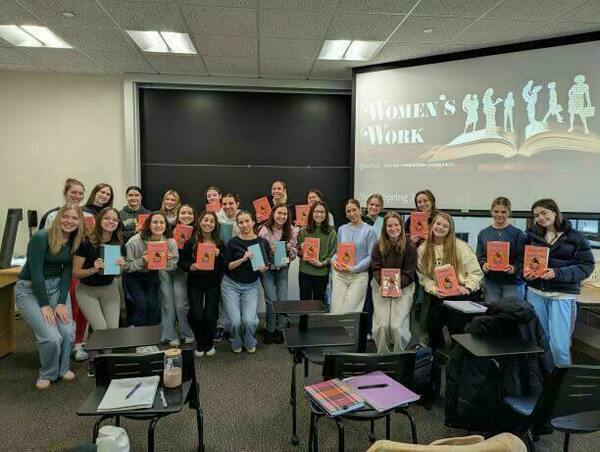
Chris Hedlintag:sheedyprogram.nd.edu,2005:News/1722712025-05-07T11:52:00-04:002025-05-12T12:16:19-04:00“Women's Work” course asks big questions of fiction and realityWill achievement make me happy? What are barriers to women’s equal pay in the workplace? Do I want children? Can women (or anyone) ‘have it all’?
These are some of the big questions students explored this spring in "Women's Work," a new course designed and taught by Dr. Chris Hedlin of Notre Dame's Sheedy Family Program in Economy, Enterprise and Society.
In the course, students took up the theme “women’s work” in three senses. First, they considered the history of gendered separate spheres in the United States—the ways in which some kinds of labor, like care work, came to be seen as properly the concern of women, while other kinds of work, like business careers, became coded masculine.
Second, they studied women’s “work” as in “works of literature”: they read bestselling novels by and about working women and probed how the fictional representations compare with women’s lived realities. The course novels included Kiley Reid’s Such a Fun Age (2019) and Bonnie Garmus’s Lessons in Chemistry (2022).
Finally, students took "women’s work" as a starting place for their own purpose-driven career discernment. They dialogued with peers and alumni about real-world issues like confronting gender biases in the workplace and balancing family and career goals.
“I was pushed to think deeply about my own life, how I want to live in the future,” said Rory Klocke ‘27, an applied math major with a Foundations of Business minor.
“Whether I want kids, the challenges I might face as a working woman—I have never thought so candidly about these topics.”
Experiential learning
Perhaps the most distinctive aspect of the course were the many opportunities students had to interface with Notre Dame alumni.
The class featured guest speakers, including Kaitlin Sullivan, Director of Content Policy at Meta and Kim Powell, co-founder of LeadScale Advisors and author of The CEO Next Door, who shared their stories and reflected on course themes.
Through partnerships with ThinkND and ND Women Connect, students conducted informational interviews with alumni volunteers and created found poetry out of the alumni’s Google Form submissions.
The students also collaborated with ND Women Connect for the spring edition of their Shared Read program, reading Lessons in Chemistry alongside ND alumni from around the world and dialoguing with them weekly on an online book discussion forum.
Finally, in place of a final exam, they helped Dr. Hedlin host a live virtual webinar on Lessons in Chemistry, which served as a culminating event for both the Shared Read program and a ThinkND series Dr. Hedlin hosted, also titled “Women’s Work,” where she interviewed experts on different aspects of women’s labor and literature. The webinar had more than 80 attendees.
The multiple alumni interactions let students observe many different answers to questions like, “What makes work meaningful?” or “How can I balance family and career?”
The alumni also modeled an investment in lifelong learning. They were reading not for a class requirement but to enrich their intellectual lives.
The course structure invited students to envision themselves as lifelong learners, too. For one of their key assignment sequences, for example, students met weekly in small dialogue groups, where they discussed the novels they were reading and connected course topics to their personal experiences.
Students also had the option to participate in a communal DEAR (Drop Everything and Read) time on the tenth floor of the Hesburgh Library each Friday morning.
If students chose to attend the communal reading time, they did not have to go through any of the usual checks on college reading assignments: no quizzes, no graded annotations, no summaries. All they had to do was read.
Women's Work students gathered for a watch party of episodes from the Apple TV+ series, "Lessons in Chemistry," and compared it to the novel.
“Sometime before college, students tend to lose the art of reading slowly and thoughtfully and in community,” Dr. Hedlin said. “There are just too many external pressures and distractions – reading quizzes, other homework, electronic devices – for many students to read for pleasure.”
Dr. Hedlin intentionally designed Women’s Work to counteract these trends. For many students in the course, it jumpstarted new or long-lost habits.
“I started reading for fun again,” said Jayne Kelly ’27, a double major in finance and philosophy and member of the Sheedy Family Program. “Instead of scrolling on my phone for an hour before bed, I would read.”
One of the key course goals was that students would approach stories, literary and personal, as a form of data – something to take seriously as a means of interrogating the gendered working life. The course taught students about different ways of reading, including digital humanities methods that make use of generative AI tools, and helped them evaluate the strengths and drawbacks of each approach.
For architecture student Ginika Kalu ’25, the focus on fiction let her encounter the course’s big questions in all their real-world complexity.
“We could read 1,001 research articles on these topics. But the novels helped us pull all the themes together.”
Women's Work was developed with the support of a Digital Learning Sprint grant from Notre Dame Learning's Office of Digital Learning (ODL), the Office of Digital Studies (ODS) in the College of Arts and Letters, and the Teaching and Learning Technologies (TLT) group in OIT.
]]>
Christine Hedlintag:sheedyprogram.nd.edu,2005:News/1722132025-05-07T09:46:00-04:002025-05-07T00:47:02-04:00Studying <em> Survivor </em> : How two Notre Dame courses apply reality TV to philosophy, psychology, and mathStudents in Dynamics of Survivor, assistant professor of the practice Brian Mulholland (bottom right), and three-time Survivor contestant Kelley Wentworth (center top) smile enthusiastically for a group photo. (Photo by Jon Hendricks/University of Notre Dame)
A soundtrack of high-tension music and drums plays in a dark room lit only by a crackling fire. Two rows of seats are filled by people wearing their best poker faces, ready to commit any betrayal necessary for victory.
One by one, each person takes a long walk out the door to a separate location where they can cast their vote — the name of who they want to permanently remove from those two rows.
What’s on the line? It might as well be life and death: extra credit.
The ritual is a regular Tuesday morning for students in the class Outwit, Outplay, Outlast: The Dynamics of Survivor. The psychology and math course uses the reality TV show Survivor as a tool to understand decision-making, and it turns students into the decision-makers.
Meanwhile this semester, in a philosophy course called The Working Life: Work, Meaning, and Happiness, students watch a season of Survivor in their pursuit of a personal philosophy of work. They focus on the social strategies in the show that can transfer into professional life, as well as the ways contestants separate their personal selves from their actions in the game.
The two courses recently converged during a visit to campus by three-time Survivor contestant Kelley Wentworth, who became aware of The Dynamics of Survivor course after senior psychology student Molly Snook posted about it on TikTok. Wentworth visited classes and spoke with students to discuss things like her mental approach to the game and how she transferred Survivor skills to her professional life — plus, of course, a few behind-the-scenes tidbits.
While Snook connected Wentworth with her class, she credits her professors for what makes The Dynamics of Survivor special.
“They took something that they enjoyed,” she said. “And they are making it such an engaging and exciting classroom to be in.”
Combining disciplines
Three-time Survivor contestant Kelley Wentworth sits in front of the Dynamics of Survivor class to answer questions about her experience on the reality TV show. (Photo by Jon Hendricks/University of Notre Dame)
In each season of Survivor, which began airing on CBS in 2000, contestants are dropped on a remote island and put into competing teams. They collaborate to survive, complete challenges, and ultimately vote out a team member every episode. Halfway through, the teams merge, and it becomes every castaway for themself. The winner of the final vote gets $1 million.
In Dynamics of Survivor, students learn about mathematical game theory and social cognitive neuroscience in class. They then split into teams for their own Survivor game and strategically apply what they’ve learned in class.
“Being on the other side of the game is a lot more interesting,” said Garret Paciorek, a senior chemical engineering student.
Even after getting voted out in the first round, Paciorek said he had better understood the necessary decisions in Survivor. He attributed his own downfall to first impressions — a psychological concept covered at the beginning of the class.
“It was cool to not only learn that,” he said, “but then also for it to be immediately applicable in the game.”
The Dynamics of Survivor is co-taught by Vanessa Chan-Devaere, an assistant teaching professor of psychology, and Brian Mulholland, an assistant professor of the practice in mathematics. They’re both members of an 8-person Notre Dame faculty watch group that meets to watch new episodes and share their reactions, which are often influenced by their varied fields of study.
“One of the reasons that I love working at Notre Dame is I feel like there are so many opportunities for myself to continue my education and show the students a love of learning."
- Brian Mulholland, assistant professor of the practice in mathematics
When Notre Dame’s course catalog needed more interdisciplinary classes, Chan-Devaere and Mulholland saw an opportunity to get creative.
Because decision-making is a large part of Survivor, Chan-Devaere and Mulholland created their joint class for students to analyze the show on a deeper, intellectual level.
“The goal of our class is to say, ‘What if we took pieces from the math perspective and from the psychology perspective and put them together?’” Chan-Devaere said.
Mulholland teaches students how to solve problems utilizing mathematical game theory and modeling tools. To properly make decisions, he said, students make assumptions, do some math, and then draw conclusions. Students are able to map out every possible decision with payoff matrices and game tree models, which can be used to strategize and operate under the assumption that everyone is maximizing their own success.
After students learn how to navigate decisions mathematically, they explore the principles of social cognitive neuroscience, which examines how our brains operate when we think, how that’s influenced by other people, and how we make decisions based on those relationships.
“Psychology researchers use games to study how the brain is involved in the decision-making process,” Chan-Devaere said. “We map those onto a season of Survivor.”
While enjoying the academic engagement of their students, Chan-Devaere and Mulholland also learn from one another’s expertise — Chan-Devaere never thought she’d utilize game trees, and Mulholland never studied the brain before the course.
“One of the reasons that I love working at Notre Dame is I feel like there are so many opportunities for myself to continue my education and show the students a love of learning,” Mulholland said.
Surviving work
During the pandemic, Paul Blaschko — another member of the faculty watch group — binge-watched 26 seasons of Survivor with his wife in a few months.
Paul Blaschko prepares students in The Working Life for a class discussion on the philosophical principles that can be explored through the show Survivor. (Photo by Jon Hendricks/University of Notre Dame)
“I became obsessed,” said Blaschko, an assistant professor of philosophy and director of the Sheedy Family Program in Economy, Enterprise, and Society. “I was just, like, transfixed — both because it’s really interesting in its own right but also because so many of the dynamics in the show mirrored dynamics that I saw both in my experience in a competitive workplace and in academia in general.”
While watching the show, Blaschko was also reading about the ethics of contemporary corporate life. This interest was inspired by unanswered questions about work in God and the Good Life, the introductory philosophy course he often teaches.
“How can we, in the contemporary world, flourish at, in, and through our work?” he said. “And that presupposes an affirmative answer to a more foundational question, which is, ‘Is it possible?’”
Blaschko developed The Working Life to answer these questions using the framework of virtue ethics, and resources from utilitarianism, and existentialism — plus a sprinkling of Survivor-ism.
Students in the philosophy course watch one season of Survivor in their pursuit of a personal philosophy of work. They focus on the social strategies in the show that can transfer into professional life, as well as the ways contestants separate their personal selves from their actions in the game.
Blaschko lets the conversation flow with the class’s intellectual curiosity.
“Let’s talk about power dynamics. Let’s talk about gender in Survivor. Let’s talk about the role that loyalty and trust play,” he said. “We could easily do a yearlong course on different seasons of Survivor and different concepts that come up.”
“Let’s talk about power dynamics. Let’s talk about gender in Survivor. Let’s talk about the role that loyalty and trust play. We could easily do a yearlong course on different seasons of Survivor and different concepts that come up.”
- Paul Blaschko, assistant professor of philosophy
Blaschko said some students are initially skeptical about watching reality TV for a class, but they warm up to it after they realize how much they can learn.
“Novelty being inserted into the classroom is the fire under a lot of people, including me,” said junior Graham Wolfe, a junior studying business analytics and impact consulting. “It makes the motivation more intrinsic.”
Wolfe is taking the class to fulfill a requirement for the Sheedy Program, which brings together students at the intersection of liberal arts and business. In addition to rigorous interdisciplinary coursework, this cohort-based program provides opportunities for career discernment, collaborative research, and meaningful dialogue — a key facet of The Working Life.
Wolfe added that seeing Survivor on the syllabus didn’t feel like a random attempt to make the class more interesting — instead, it was the perfect tool to make the class material more tangible.
“A key criticism of philosophy is that it’s detached from reality,” said Luke Donoghue, a Sheedy Program sophomore majoring in finance and global affairs and minoring in Chinese. “In Survivor, you get to see real emotions from people.”
While reality TV is not a traditional academic tool, Blaschko argues that anything from pop culture can inspire philosophical conversations. Scholars just need to ask the right questions.
“Often for me, watching Cops or Love Is Blind or Survivor with at least just a little bit of a critical lens provides as much insight into the human condition as a thousand academic articles,” Blaschko said. “Anybody can watch Survivor, and anybody can engage in a deep dialogue about what it means.”
Originally published by Adah McMillan at al.nd.edu on April 28, 2025.
]]>
Adah McMillantag:sheedyprogram.nd.edu,2005:News/1718652025-04-24T09:17:00-04:002025-05-07T10:59:15-04:00“Know your north star”: Katherine Jollon Colsher calls students to lead with purpose
“I succeed the most when I work for people who push me past my comfort zone—but will catch me if I fall.”
With this powerful reflection, Katherine Jollon Colsher, CEO of Girls Who Invest, delivered one of many memorable insights during her visit to Notre Dame as a guest speaker for the Sheedy Family Program. Through both a Dinner and Dialogue event, a student lunch session, and a panel discussion with Girls Who Invest alumni, Colsher offered students a candid, inspiring look at what it means to build a meaningful and resilient career.
Colsher used the story of her own multifaceted career journey—from a consulting firm to Bono’s nonprofit the One Campaign to philanthropy work at Goldman Sachs and now her mission-driven leadership at GWI—to emphasize that professional growth is often nonlinear. She explained how challenges along the way, what she called professional “bruises,” had prompted her to pivot, reflect, and ultimately grow.
Colsher underscored how transformative it can be when mentors or colleagues champion your success.
“I’ve been fortunate that people have been invested in me and my growth,” she said. Human connections, both long-standing, slow-growing relationships and quick unexpected encounters, she said, shaped her path in permanent ways.
Colsher sharing her career lessons prior to dinner and dialogue.
During her dinner presentation, Colsher spoke about the responsibility that comes with having influence. She described moments in her career when she found herself in unexpected circles of influence, and she chose to advance her ideas and vision within the scope of her roles.
For her, having a client-service model keeps her focused on the human impact of her work.
“It’s always about the people you’re serving,” she said. Throughout both sessions, Colsher returned to a key message: success comes not from a rigid five-year plan, but from building agency—starting now.
Students often feel pressure to have every step mapped out, she said. But Colsher challenged this mindset. She shared with students that no one has a step-by-step five-year plan. The key, she emphasized, is to practice exercising agency and standing up for your vision and values, building “muscle memory” in those acts.
She encouraged students to embrace persistence through difficulty, noting that staying in a role through tough times often leads to the most significant growth. Hard times aren’t always a reason to pivot. They can be moments to lean in and learn. This perspective resonated with many Sheedy students, especially as they prepare to navigate an unpredictable post-graduate landscape.
Sheedy student who attended “Honest talk: Your career search on the ground”, the lunch event with Colsher.
Colsher reminded students never to burn bridges, recognizing that networking often happens in unplanned, serendipitous ways. She also emphasized the power of promises.
“Keeping promises also means saying no,” she said, pointing to boundaries as key to preserving one's integrity.
Sophia Salatino ’26, a political science and finance double major, found herself reflecting at lunch on the difficulty of being the first in your family to enter a new career field.
“It can be scary,” she said. But Colsher’s insights helped her think more broadly about her network. “There are people in every setting who are willing to be mentors and role models, you just have to reach out and ask for it.”
In a particularly memorable moment, Colsher posed her “big question” to students at the conclusion of her talk—a hallmark of the Sheedy Dinner and Dialogue series.
“As you approach your career, how will you use your voice in a distinct way? How can you use your distinct voice to amplify the voices of others?” she shared in a concluding slide. It was a call not just to lead, but to uplift.
Her Notre Dame visit didn’t end at the podium. Colsher carved out time to connect personally with Sheedy students and even meet with alumni of Girls Who Invest currently on campus. It was yet another reflection of her commitment to relationship-building and empowering others—living proof of the mission-driven leadership she encourages in others.
As Sheedy students reflect on Colsher’s visit, they are left with both inspiration and challenge: to know their North Star, to lean into discomfort, and to speak—and act—with purpose.
Marcela Rodriguez Holguin is a junior from Houston, Texas, double majoring in Marketing and Visual Communication Design and a minor in Latino Studies. On campus, she is engaged in advocacy and education. She is part of the Media team for the Sheedy Family Program and enjoys serving the South Bend community through volunteering with different organizations.
]]>
Marcela Rodriguez Holguintag:sheedyprogram.nd.edu,2005:News/1714662025-04-11T09:24:00-04:002025-05-07T11:00:02-04:00Exploring careers and building connections: Sheedy Family Program takes on Chicago
By: Paige Weniger '27
Group picture with the Google employees that joined us for a panel and tour of their building.Group picture of our Sheedy students with the LinkedIn employees that joined us for a career panel.
For Shaliza Kassam, Head of Global Sales Engineering, Talent & Learning at LinkedIn, asking for help is one of the most important ways to advance your career.
“Closed mouths don't get fed,” she said. “It’s hard to ask for help, so you have to actively work on it.”
Weniger was just one of more than a dozen business leaders with whom students in the Sheedy Family Program in Economy, Enterprise and Society interfaced during their annual Business Trek to Chicago in February.
The Trek, held each spring, is an intensive, two-and-a-half-day experience designed to give students a glimpse into the professional world they will enter post-graduation. It features site visits, alumni conversations, career development workshops, and community building activities.
Students have opportunities to network with leaders in major companies, dialogue about their own career decisions, and explore all that Chicago has to offer young business professionals. This year 32 sophomore and junior Sheedys participated.
Vijen Patel '08, sharing his experience as an entrepreneur as the Dinner and Dialogue speaker during the trek.Sheedy students dialoguing about the questions posed by Justin Kuryliw, Solution Architect at Salesforce.
Learning from Leaders Across Industries
Students on the Business Trek visited the Chicago offices of LinkedIn, Google, and the private equity firm Shore Capital Partners. They also heard presentations and talked in small groups over meals with Patrick Sheedy of Borealis, Justin Kuryliw from SalesForce, and Vijen Patel, the former CEO of Pressbox (now Tide Cleaners) and founder of The 81 Collection.
In his keynote address to students, Patel emphasized the importance of having courage and taking chances in your career, noting that his current role emerged from a series of calculated risks and unexpected opportunities.
In the evenings and between sessions, students participated in structured dialogue sessions and professionalization workshops on topics like networking, delivering personal introductions, and asking strong questions. These discussions provided space to learn from one another and reflect.
“It was encouraging to realize that it’s okay not to have it all figured out yet,” said Sheedy student Mary Storino ‘27, an Economics major with a minor in Business.
The trip fostered students’ professional development but also a sense of community, she continued. Whether it was debriefing site visits on the bus, discussing career aspirations over dinner, or yelling at peers during a game of Scattergories, the trek strengthened relationships that she knew would “last far beyond the weekend.”
“The Trek reminded me that a career journey is just that: a journey,” Storino said. “It’s about making connections and allowing the people around us to teach and help us.”
Paige Weniger is a sophomore in the Sheedy Family Program majoring in Political Science, with minors in Marketing and History. She has experience in public service, legal research, and political advocacy.
]]>
Marcela Rodriguez Holguintag:sheedyprogram.nd.edu,2005:News/1714642025-04-08T09:04:00-04:002025-05-07T11:00:35-04:00Sheedy speaker Kaitlin Sullivan ‘10 coaches students in the art of decision-making
By: Teresa Kadapurath '27
“Five-year plans are overrated.”
That was just the first of three bold lessons that Kaitlin Sullivan ‘10, Director of Content Policy at Meta, offered at the March edition of Sheedy Family Program’s hallmark Dinner and Dialogue series.
Sullivan, who majored in political science and minored in philosophy, politics, and economics (PPE), immediately challenged conventional career wisdom.
Drawing examples from her own nonlinear career path – from advocacy work in the Jesuit Volunteer Corps to a full-time role at a rape crisis center in California to an unexpected internship in content policy at Facebook in Washington D.C. – Sullivan emphasized the unpredictability of the professional landscape.
“Five-year plans are overrated," she asserted, explaining that, while having goals is valuable, remaining open to unforeseen opportunities and shifts is paramount.
Kaitlin Sullivan talks about the three lessons she has learned throughout her career journey.
Sullivan’s second takeaway for students, drawn directly from her 12 years of experience in content policy, was a framework for effective decision making.
At Meta, as she described, she grapples with decisions impacting billions of users. In that line of work, she appreciates the distinction, first coined by Jeff Bezos, between “one-way doors” – significant, often irreversible decisions like major product launches – and “two-way doors” – choices that can be easily reversed.
Her advice was pointed: “When the stakes are low, just make the decision and move on. When it’s a one-way door, that’s when you want to slow down and really consider your options.”
Perhaps Sullivan's most impactful insight centered on the often-overlooked consequence of inaction. “Not making a decision is making a decision,” she said.
She illustrated this with a vivid anecdote from a Meta product review meeting, where endless critiques led to a standstill. A colleague's blunt observation – that the team's failure to choose was, in effect, choosing the status quo – served as a powerful wake-up call. This resonated deeply with Sheedy student Jayne Kelly ’27, a finance and philosophy double major, who acknowledged the ease of postponing tough calls and the resulting stagnation.
In the final portion of her talk, Sullivan connected her present-day insights to her Notre Dame education, recalling a formative lesson from preeminent philosopher and Notre Dame professor Dr. Alastair MacIntyre.
In an early assignment in a philosophy class, MacIntyre tasked the students with answering the question, “What is the most important thing to learn while at university?”
Kaitlin Sullivan talking with Sheedy students at her seminar "Governance in Online Speech."
The correct answer, according to MacIntyre, was to “learn how to learn.” And that stuck with Sullivan. She shared how “learning how to learn” has been instrumental throughout her career, especially in moments of change like navigating a new team or tackling an unfamiliar challenge.
In her concluding remarks, Sullivan urged students to embrace challenges with curiosity and an “abundance mindset.”
When confronted with difficult decisions, or ideas that seem far-fetched or ill-advised, she urged students to pause their knee-jerk reactions. “Assume you said yes already,” she said. What would that mean for your next steps?
In her experience, this subtle shift in perspective, she explained, fosters a willingness to learn from others and cultivate innovative solutions.
The evening culminated in a clear call to action for the Sheedy students: as they embark on their own career paths, they must embrace uncertainty, maintain a thirst for knowledge, and recognize that decisive action – even when challenging – is the key to shaping their futures.
Teresa Kadapurath is a sophomore studying Economics with minors in Real Estate and Sustainability. Passionate about sustainability, she has interned with the Farmlink Project to help companies reduce food waste and transition to net-zero emissions, as well as contributing to sustainable agriculture efforts in Karnataka, India.
]]>
Marcela Rodriguez Holguintag:sheedyprogram.nd.edu,2005:News/1709392025-03-21T13:00:00-04:002025-03-21T12:21:36-04:00Sheedy entrepreneur Brian George ‘25 hosts IDEA Center panel on “Choosing Hard”
When faced with adversity in a venture, do you seek an easy way out or embrace a challenge? How can mentors help push you to overcome adversity? How can faith be a resource in the startup journey?
These were the questions at the heart of “Choosing Hard: Tales of Faith, Grit, and Alumni Collaboration from ND Entrepreneurs,” a panel discussion at the IDEA Center on February 20, 2025, organized by Sheedy student Brian George ‘25 and his Routora startup partner Luke Blazek ‘25.
An audience of over 100 people listens as panelists at the "Choosing Hard" event discuss the challenges of entrepreneurship, the role of faith in decision-making, and the importance of mentorship and alumni partnerships in navigating career paths.
“Luke and I have been incredibly fortunate to learn from many mentors at Notre Dame as we turned our idea into a business,” George said. “We wanted to create an outlet where others could learn from the experiences of entrepreneurs at different stages.”
George sensed that conversations about faith and entrepreneurship were rare. He wanted to create an event where founders could share how faith serves as an anchor in their work, helping them stay grounded in times of adversity.
The Choosing Hard event brought together students, faculty, entrepreneurs, and other guests to explore what it means to choose hard – a mantra popularized by Notre Dame head football coach Marcus Freeman.
Although most people link the mantra “choose hard” with Notre Dame football, for George and Blazek, another association came to mind.
In October 2024, Blazek had heard Notre Dame football chaplain Father Nate Wills give a homily on the theme, using it as a call to embrace faith, commitment, and meaningful challenges in daily life. George and Blazek saw an opportunity to apply Wills’ perspective to entrepreneurship.
George and Blazek have experience in that space. They are the co-founders of Routora, a fleet management software that optimizes multi-stop routes to reduce fuel costs, drive time, and carbon emissions for businesses. George is a finance major with a science, technology, and values minor and Blazek is a political science major with minors in economics and innovation and entrepreneurship.
They were joined on the panel by Alessandro DiSanto, who co-founded the Hallow app; Tracy Graham, who established Graham Allen Partners; and Chris Murphy, who serves as chairman and CEO of First Source Bank.
George and Blazek designed the panel to encourage vulnerability. They invited the founders to open up about the real struggles they faced, the moments of doubt they endured, and the role faith played in helping them stay grounded.
When Adversity Becomes Advantage
As George and Blazek framed the focus of the panel, they drew from personal experiences.
In 2022, Blazek was diagnosed with an autoimmune disease that forced him to take a year-long medical leave from school. Still, his and George’s partnership endured. Amid Blazek’s medical appointments and living a thousand miles apart, they continued building Routora.
Brian George (center) greets and welcomes distinguished members of our community before the event. Pictured from left to right: Professor Tom Gallagher, Alessandro DiSanto, Father Pete, and Tracy Graham.
“During the darkest periods of my life,” Luke shared, “Brian believed in me.”
George felt the same support from his co-founder. He, too, knew what it meant to overcome challenges. George had arrived in the United States as an immigrant in 2007 with no knowledge of the English language. For the first several years after arriving, he struggled to form basic sentences, and had undergone years of speech therapy and ESL instruction.
“Those early struggles ingrained lessons about persistence and repetition, shaping how I now approach both business and relationships,” George said.
Their resilience and faith in one other paid off. Today, Routora serves tens of thousands of users and has partnered with the City of New York.
“Turn adversity into advantage, uncertainty into opportunity, rejection into resolve,” Blazek said.
Lessons in Leadership
George and Blazek were joined by preeminent leaders in fields as diverse as faith-driven entrepreneurship, business leadership, and banking. Each shared their journey of overcoming obstacles and finding purpose in their work.
Alessandro DiSanto, co-founder of the Hallow app, left a successful finance career to create the number one Catholic prayer app. He emphasized the importance of balancing passion and hard work.
“Each of those in isolation without the other can lead to big problems," he said.
DiSanto spoke about the Lord’s Prayer and the significance of the phrase “Give us this day our daily bread.” He noted that the repetition – “day” and “daily” – is not redundant. It serves as a reminder to focus on the present rather than becoming overwhelmed by the unknown.
Tracy Graham is a serial entrepreneur and now runs his own private equity firm, Graham Allen Partners, based in South Bend.
Graham grew up on Chicago’s South Side. The son of a single mother who never finished grade school and a father he never met, Graham’s life changed when he received a Notre Dame football scholarship. Then, when injuries ended his NFL dreams, it changed again. He had to find a new path.
“I never knew about business. All I knew was that I wanted to go pro,” he said.
For Graham, that second new start began when fellow panelist Chris Murphy took a chance on him and gave him an $80,000 loan. That was 28 years ago.
Carolyn Woo, former Dean of the Mendoza College of Business, stands up from the audience to ask a question to the panelists.
He credited the Notre Dame network for opening doors and shaping his career.
“The power of Notre Dame and the people of Notre Dame was strong enough to propel me to be anything I wanted,” he reflected. He also emphasized how the discipline he learned from football translated directly to business.
“You need to get reps, stay late, depend on teammates, and be committed to a mission.”
Chris Murphy, Chairman and CEO of First Source Bank, shared insights on leadership and service. Although he initially planned to follow his family’s medical legacy, he eventually found his true calling in commercial banking.
In 1971, he joined his father-in-law to purchase what would become First Source Bank. Between then and now, he grew the company from a $7 million investment to over $2 billion in equity without taking on debt.
Murphy encouraged attendees to focus on significance rather than success.
“Most success is measured by the things you have—the house, the car, the toys. But when you die, all those are gone. What you want is significance. The way you get significance is through the people you touch, the lives you affect, and the goodness you've done that is left behind when you're gone.”
A Call to Action
For George, the primary goal of the Choosing Hard event was to give audience members a renewed sense of purpose. Founding a startup isn’t easy. But, as Father Nate Wills, Marcus Freeman, and the evening’s panelists all urged, there can be merit in “choosing hard.”
George recognized how his time at Notre Dame and in the Sheedy Family Program had helped him cultivate these values.
George said, “Organizing this panel and hearing from the other speakers reminded me of my own goals or values: thinking critically, serving boldly, and embracing discomfort to grow.”
]]>
Chris Hedlintag:sheedyprogram.nd.edu,2005:News/1704912025-03-05T09:00:00-05:002025-03-04T16:08:10-05:00Co-author of The CEO Next Door Kim Powell asks Sheedy Students to adopt an ‘agent mindset’
By: Rohan Jaipuria’27
“Can you outperform in all areas of your life? Can you have it all?"
These thought-provoking questions centered the discussion led by Kim Powell ’98 – co-author of the New York Times bestseller The CEO Next Door and co-founder and managing partner of LeadScale Advisors – during her presentation at the Sheedy Family Program’s Thursday, February 13 dinner.
Powell ’98, a Notre Dame graduate with majors in History and French, has spent over 25 years studying and refining effective leadership strategies. She began her career at Boston Consulting Group (BCG), where, as she explained to students at the Sheedy Dinner, she embraced every opportunity to learn while tackling complex business challenges for clients.
In her talk, she described her time at BCG as part of her career’s “foundational learning phase,” that is, the period of her career when she was building a broad skill set and discovering her professional interests.
Her next phase – her self-described “passion phase” – began when she joined the leadership advisory firm ghSMART and eventually led her to found LeaderScale Advisors. In her current role, she is an executive coach who empowers leaders of global firms to sharpen their decision making skills and turn effective leadership strategies into impactful action.
Kim Powell speaking about her career journey and rating the "holistic satisfaction" she felt at different points in her timeline.
Powell said she never expected to write a book as part of her career journey. Yet her deep interest in tracking the traits of successful CEOs – what she describes in her work as mapping the CEO genome – culminated in her co-authoring The CEO Next Door. It was named the 2019 CMI Management Book of the Year.
At the heart of Powell’s presentation was a challenge to students: to cultivate an “agent mindset” — a willingness to take ownership over their choices, rather than succumbing to setbacks.
In her presentation, she shared a pivotal moment in her career when a client gave her harsh feedback while she was simultaneously finalizing edits for her book. The criticism shook her, yet instead of retreating, she chose to engage. That client is now a trusted colleague.
“Be an agent, not a victim,” Powell said. “Lean into the pain and the discomfort. Good things will come out of it."
Brian George ’25, a finance and history double major in the Sheedy Family Program, found Powell’s message to be a “call for the importance of communication.” He appreciated her willingness to share the “wake-up call” moments in her own career, where she grew professionally from confronting difficulty.
While on campus Powell also engaged with students in smaller group settings. She participated in a discussion of her book; visited the Sheedy course, “Women’s Work”; and led a seminar titled, “Getting Hired: How do employers identify ‘A Players’?” among other events.
For one such small-group conversation, students took the CEO Genome Quiz, a tool Powell co-designed, to assess their leadership strengths in comparison to high-performing CEOs.
During the session, Powell characterized “reliable delivery,” one of the four core components of the CEO Genome, as “the art of setting expectations.” She stressed the importance of intellectual humility.
“Good leaders know what they don’t know,” she said. She advised students that, if they are unsure what to do next in their professional lives, recall that “someone has faced this before,” and seek guidance rather than struggle in isolation.
Mary Williams ’27, an economics major who attended Powell’s afternoon seminar and the “Women’s Work” class visit, was especially struck by Powell’s insight into the role of failure in successful CEOs’ careers.
“A-players who have failed in some aspect of their job and demonstrate how they have learned from it are the ones most likely to stand out to recruiters,” Powell said.
As Williams prepares for recruitment season, she said she is grateful for Powell’s guidance on leveraging past experiences to navigate future opportunities.
Powell’s visit provided Sheedy students with invaluable insights on leadership and the agent mindset, challenging students to reconsider their approach to their professional and personal development.
Rohan Jaipuria ’27 is an economics major with minors in entrepreneurship and data science. In addition to being part of the Sheedy Family Program, he is a Glynn Family Honors student, an IDEA Center Fellow, and a research assistant at the McKenna Center, where he explores entrepreneurship as a pathway out of poverty. Rohan is also active in the Federal and Fiscal Challenge Club and leads a consulting project in the Student International Business Council.
]]>
Marcela Rodriguez Holguintag:sheedyprogram.nd.edu,2005:News/1696142025-01-29T13:12:00-05:002025-05-07T11:01:06-04:00Unforgettable: A Sheedy student’s experience at "The Joys of VMS" conference
By Maire Brennan
This past November, I had the extraordinary opportunity to attend the Joys of VMS conference in Longboat Key, Florida. Alongside five other Notre Dame students, including fellow Sheedy scholars Connor Moore and Brian George, I spent three days immersed in the world of vertical market software (VMS) and long-term investing.
The conference brought together operators, investors, and innovators from around the globe. To me, it embodied the defining ethos of a Notre Dame education and the Sheedy Family Program. It showed me that, whether you are a student or a professional, business demands – and is enriched by – meaningful dialogue across disciplines.
The stunning St. Regis Resort in Longboat Key, Florida, set the perfect backdrop for three days of learning, networking, and inspiration at 'The Joys of VMS' conferenceSheedy students Maire Brennan, Connor Moore, and Brian George enjoying a lively networking event in front of a picturesque sunset during the first night of the conference.
I came across the opportunity to attend through a course I took in the fall of 2024 called The Art of Investing (AOI). I was drawn to this course—one of the recommended electives for Sheedy—after AOI professors Patty Brady, Rick Buhrman, and Paul Buser gave a guest lecture in Business in Context the previous year.
A capstone course offered through the Notre Dame Institute for Global Investing, AOI “aim[s] at weaving together wisdom from across the liberal arts and other disciplines in the pursuit of mastery as an investor,” as the course website states. The class is composed of students from various backgrounds and majors, creating a truly interdisciplinary environment.
Mitch Rales, co-founder of Danaher, discussing “The Art of Company Building” with Daniel Eisen and Jan Mohr
As an accountancy major who was admittedly unfamiliar with investing, I felt this course would be the perfect opportunity to learn about the field through an untraditional lens. Throughout the course, we heard from faculty and practitioners ranging from CEOs to top investors to industry leaders, each with a unique perspective on the “questions facing companies, our society, and the human condition.”
When Profs. Burhman and Buser invited AOI students to apply to attend the Joys of VMS conference, an all-inclusive investing conference they were hosting in Florida, I knew it was an incredible opportunity to build upon the lessons we had started in the classroom. Eager to enhance my understanding of investing (and, let’s be honest, to escape the South Bend winter), I applied—and was thrilled to be selected.
From the Classroom to the Conference Room
Over the three day conference, we explored topics such as building high-performing operating teams, aligning incentives for long-term success, and the impact of artificial intelligence on VMS platforms – all with a backdrop of optional morning paddleboarding sessions and breathtaking sunsets.
The agenda featured an impressive lineup of panels featuring some of the most distinguished leaders in the vertical market software space. Most exciting for me was hearing from Mitch Rales of Danaher Corporation, a global leader in the life sciences that is widely studied in business schools for its operational excellence, and Will Thorndike, author of The Outsiders: Eight Unconventional CEOs and Their Radically Rational Blueprint for Success. At Notre Dame, my curriculum had included case studies on both Danaher and The Outsiders, so this was a unique opportunity to expand discussions that started in the classroom to include the business leaders themselves.
Simply listening to these speakers would have been a privilege, but Profs. Buhrman and Buser went one step further, generously including us students in the programming by having us take turns introducing the speakers at each session. The opportunity gave us a chance to practice our public speaking skills and engage directly with the conference attendees. I got to introduce Will Thorndike, whose book we analyzed in AOI.
Notre Dame students find South Bend natives among the attendees during the informal networking event
A Very ‘Sheedy’ Experience
Both at the speaker sessions and in conversations during networking events and shared meals, I learned about the diverse paths that the conference attendees had taken to success. Their stories reinforced the value of intellectual curiosity, adaptability, and the ability to see connections between seemingly unrelated disciplines—all hallmarks of a Notre Dame, and even more specifically, a Sheedy education.
Without the Sheedy Family Program and generous mentors like Rick Buhrman and Paul Buser, I likely never would have had the courage to take a class outside of my majors like AOI, let alone attend a conference surrounded by highly accomplished professionals in a field that was foreign to me.
And my peers in the Sheedy Family Program have a role in that, too. I don’t think it was a coincidence that three out of the six students selected to attend were part of the Sheedy Family Program. It’s a testament to the program’s ability to attract students who are genuinely passionate about engaging with disciplines beyond their own and supporting their academic and professional growth.
I was struck, after returning home, that the Joy of VMS conference was a testament to what Notre Dame, the Art of Investing course, and the Sheedy Family Program do best: fostering connections between fields or ways of thinking, nurturing curiosity, and opening doors to transformative experiences. It’s an example of how thoughtful mentorship and a commitment to a well-rounded education can elevate a student’s trajectory in profound ways.
Maire ‘25 Brennan is an Accountancy major with a minor in Constitutional Studies.