
Will achievement make me happy? What are barriers to women’s equal pay in the workplace? Do I want children? Can women (or anyone) ‘have it all’?
These are some of the big questions students explored this spring in "Women's Work," a new course designed and taught by Dr. Chris Hedlin of Notre Dame's Sheedy Family Program in Economy, Enterprise and Society.
In the course, students took up the theme “women’s work” in three senses. First, they considered the history of gendered separate spheres in the United States—the ways in which some kinds of labor, like care work, came to be seen as properly the concern of women, while other kinds of work, like business careers, became coded masculine.
Second, they studied women’s “work” as in “works of literature”: they read bestselling novels by and about working women and probed how the fictional representations compare with women’s lived realities. The course novels included Kiley Reid’s Such a Fun Age (2019) and Bonnie Garmus’s Lessons in Chemistry (2022).
Finally, students took "women’s work" as a starting place for their own purpose-driven career discernment. They dialogued with peers and alumni about real-world issues like confronting gender biases in the workplace and balancing family and career goals.
“I was pushed to think deeply about my own life, how I want to live in the future,” said Rory Klocke ‘27, an applied math major with a Foundations of Business minor.
“Whether I want kids, the challenges I might face as a working woman—I have never thought so candidly about these topics.”
Experiential learning
Perhaps the most distinctive aspect of the course were the many opportunities students had to interface with Notre Dame alumni.
The class featured guest speakers, including Kaitlin Sullivan, Director of Content Policy at Meta and Kim Powell, co-founder of LeadScale Advisors and author of The CEO Next Door, who shared their stories and reflected on course themes.
Through partnerships with ThinkND and ND Women Connect, students conducted informational interviews with alumni volunteers and created found poetry out of the alumni’s Google Form submissions.
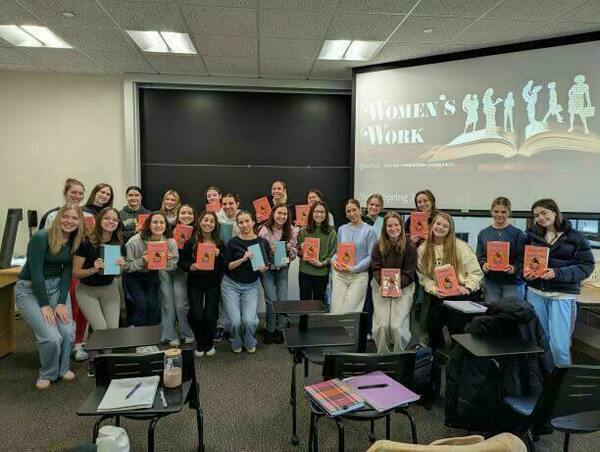
The students also collaborated with ND Women Connect for the spring edition of their Shared Read program, reading Lessons in Chemistry alongside ND alumni from around the world and dialoguing with them weekly on an online book discussion forum.
Finally, in place of a final exam, they helped Dr. Hedlin host a live virtual webinar on Lessons in Chemistry, which served as a culminating event for both the Shared Read program and a ThinkND series Dr. Hedlin hosted, also titled “Women’s Work,” where she interviewed experts on different aspects of women’s labor and literature. The webinar had more than 80 attendees.
The multiple alumni interactions let students observe many different answers to questions like, “What makes work meaningful?” or “How can I balance family and career?”
The alumni also modeled an investment in lifelong learning. They were reading not for a class requirement but to enrich their intellectual lives.
The course structure invited students to envision themselves as lifelong learners, too. For one of their key assignment sequences, for example, students met weekly in small dialogue groups, where they discussed the novels they were reading and connected course topics to their personal experiences.
Students also had the option to participate in a communal DEAR (Drop Everything and Read) time on the tenth floor of the Hesburgh Library each Friday morning.
If students chose to attend the communal reading time, they did not have to go through any of the usual checks on college reading assignments: no quizzes, no graded annotations, no summaries. All they had to do was read.

“Sometime before college, students tend to lose the art of reading slowly and thoughtfully and in community,” Dr. Hedlin said. “There are just too many external pressures and distractions – reading quizzes, other homework, electronic devices – for many students to read for pleasure.”
Dr. Hedlin intentionally designed Women’s Work to counteract these trends. For many students in the course, it jumpstarted new or long-lost habits.
“I started reading for fun again,” said Jayne Kelly ’27, a double major in finance and philosophy and member of the Sheedy Family Program. “Instead of scrolling on my phone for an hour before bed, I would read.”
One of the key course goals was that students would approach stories, literary and personal, as a form of data – something to take seriously as a means of interrogating the gendered working life. The course taught students about different ways of reading, including digital humanities methods that make use of generative AI tools, and helped them evaluate the strengths and drawbacks of each approach.
For architecture student Ginika Kalu ’25, the focus on fiction let her encounter the course’s big questions in all their real-world complexity.
“We could read 1,001 research articles on these topics. But the novels helped us pull all the themes together.”
Women's Work was developed with the support of a Digital Learning Sprint grant from Notre Dame Learning's Office of Digital Learning (ODL), the Office of Digital Studies (ODS) in the College of Arts and Letters, and the Teaching and Learning Technologies (TLT) group in OIT.