“What are you going to do with that?”: How a liberal arts education is both good and useful
In the middle of the San Gabriel Mountains outside Los Angeles, there is a famous bridge. It is a beautiful sight, with its hard, sleek lines set against the rugged mountainsides, as it stretches 120 feet high above the San Gabriel River, supported by an elegant concrete arch.
There’s one problem with it: no road connects to it at either end.1 It was built during the Great Depression as part of a highway through the mountain range. But the road was only partially complete when a massive flood washed it away. The entire project was soon abandoned. And so it remains a “bridge to nowhere,” stranded in the wilderness.
Critics of the liberal arts sometimes suggest that a broad, humanistic education is a bit like the “bridge to nowhere”: Considered on its own, it may be beautiful or compelling, but it is not pre-professional or vocational training. And this, these critics claim, makes it disconnected, impractical, or even useless.
This understanding of a liberal arts education is common. It’s easy to discern something like it in the question “What are you going to do with that?”—a question nearly every student hears as soon as they decide to study a subject that is not directly linked with a specific job or profession.

Sometimes defenders of the liberal arts inadvertently deepen this misunderstanding. They sometimes draw a sharp contrast between the liberal arts and the “servile arts.” The servile arts, in this case, are those studies that, according to one writer, “enable one to be a servant—of another person, of the state, of a corporation, or of a business—and to earn a living.”2 Given this opposition, it seems only natural to conclude that proponents of a liberal arts education acknowledge or even celebrate the liberal arts' so-called uselessness.
Saint John Henry Newman knew better. Over 150 years ago, Newman offered a different, more nuanced take on this opposition. He insisted that “a liberal education is truly and fully a useful, though it be not a professional, education.” The key, he said, was to get the priorities of education right. The aim of a liberal arts education is not usefulness but “the cultivation of the intellect.” However, “a cultivated intellect, because it is a good in itself, brings with it a power and a grace to every work and occupation which it undertakes, and enables us to be more useful, and to a greater number.”
To put it simply: A liberal arts education is useful because it is good, not good because it is useful.
How, exactly, will this kind of education prove useful? Newman is never short of examples.
For one thing, it leads to better judgment and more effective communication, giving the student "a clear conscious view of his own opinions and judgments, a truth in developing them, an eloquence in expressing them, and a force in urging them.” It also sharpens attention, sense-making, and analysis, empowering us to “see things as they are, to go right to the point, to disentangle a skein of thought, to detect what is sophistical, and to discard what is irrelevant.” Newman had no quibbles with stating that this kind of education is an excellent preparation for a career. It enables a person, he says, to “fill any post [i.e., job or position] with credit, and to master any subject with facility.”3
Of course, many changes in business, technology, and professional life lie between Newman and us. The world of work has changed dramatically and continues to change rapidly. Nevertheless, in recent decades, it has often been the leaders at the very cusp of technological and social change who have been the most vocal in praising the power and importance of the liberal arts.
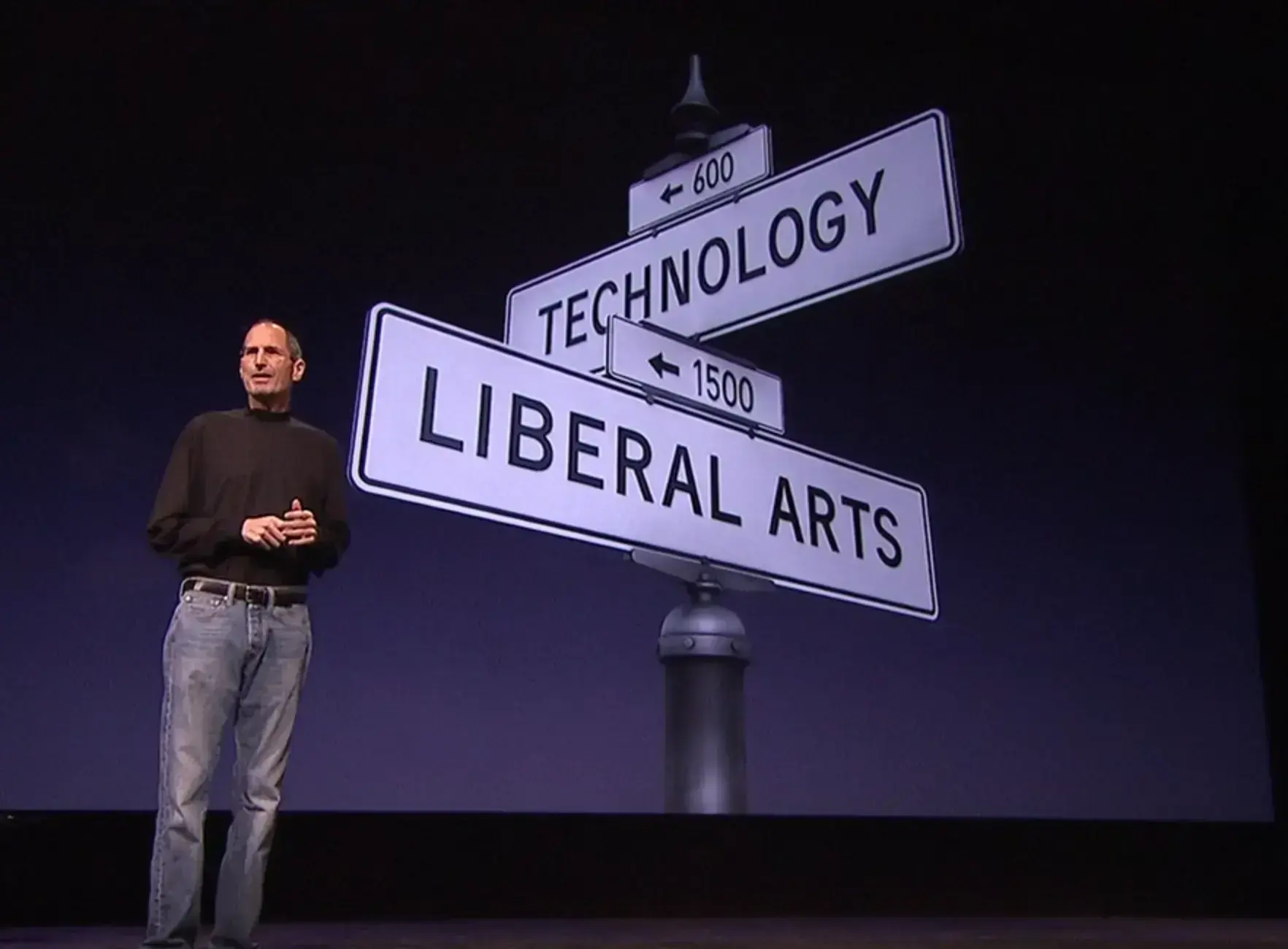
As Steve Jobs was working to transform computing as the CEO of Apple, he claimed, “It’s in Apple’s DNA that technology alone is not enough—it’s technology married with liberal arts, married with the humanities, that yields us the results that make our heart sing.”4
Similarly, as he observed and studied the rise of “knowledge work” and the development of the modern corporation, Peter F. Drucker, the so-called “father of management science,” called for a “liberal arts” approach to management. He explained that effective managers “draw upon all of the knowledges and insights of the humanities and social sciences—on psychology and philosophy, on economics and history, on the physical sciences and ethics.”5
More recently, Daniela Amodei, co-founder of the artificial intelligence company Anthropic, has claimed that “studying the humanities is going to be more important than ever” because in a world saturated with AI, we need people who excel at “things that make us uniquely human, understanding ourselves, understanding history, understanding what makes us tick.”6
What these statements have in common is precisely what makes the liberal arts so different from a "bridge to nowhere": The liberal arts are all about connection. As the historian William Cronon puts it, "listening, reading, talking, writing, puzzle solving, truth seeking, seeing through other people’s eyes, leading, working in a community—is finally about connecting. A liberal education is about gaining the power and the wisdom, the generosity and the freedom to connect."7
We at the Sheedy Family Program work to enact this "connected" approach to liberal arts education. In our courses, research, and scholarship, we avoid reducing the liberal arts to simple job training. At the same time, we don't shy away from exploring and emphasizing the wide range of reasons a liberal arts education is useful and practical. We help students, through the liberal arts, to develop not just skills but virtues, to find not just a job but a purpose, and to pursue not just a career but a calling.
Notes
-
Brian Brenner, "A Bridge to Nowhere," Civil Engineering Source, American Society of Civil Engineers, May 27, 2025, https://www.asce.org/publications-and-news/civil-engineering-source/article/2025/05/28/a-bridge-to-nowhere. ↩
-
Sister Miriam Joseph, The Trivium: The Liberal Arts of Logic, Grammar, and Rhetoric, ed. Marguerite McGlinn (Philadelphia: Paul Dry Books, 2002), 5. ↩
-
John Henry Newman, The Idea of a University, "Discourse 7: Knowledge Viewed in Relation to Professional Skill," Newman Reader, https://www.newmanreader.org/works/idea/discourse7.html. ↩
-
Steve Jobs, "Apple Special Event March 2011" (keynote address, San Francisco, CA, March 2, 2011), video recording, 1:11:45, Internet Archive, https://archive.org/details/apple-march-2011. ↩
-
Peter F. Drucker, The New Realities: In Government and Politics, in Economics and Business, in Society and World View (New York: Harper & Row, 1989). ↩
-
ABC News, "Anthropic Co-founder Daniela Amodei on Responsible AI and Anthropic's First Super Bowl Ad," YouTube video, February 6, 2026, interview by Rebecca Jarvis, 12:15, https://youtu.be/qUDG06BvWxc?si=zVDmYazeK4rOYwm_. ↩
-
William Cronon, "Only Connect: The Goals of a Liberal Education," The American Scholar 67, no. 4 (Autumn 1998): 78. ↩